3D-Printed Hydroponics
Prototyping hydroponic system parts with 3D printing.
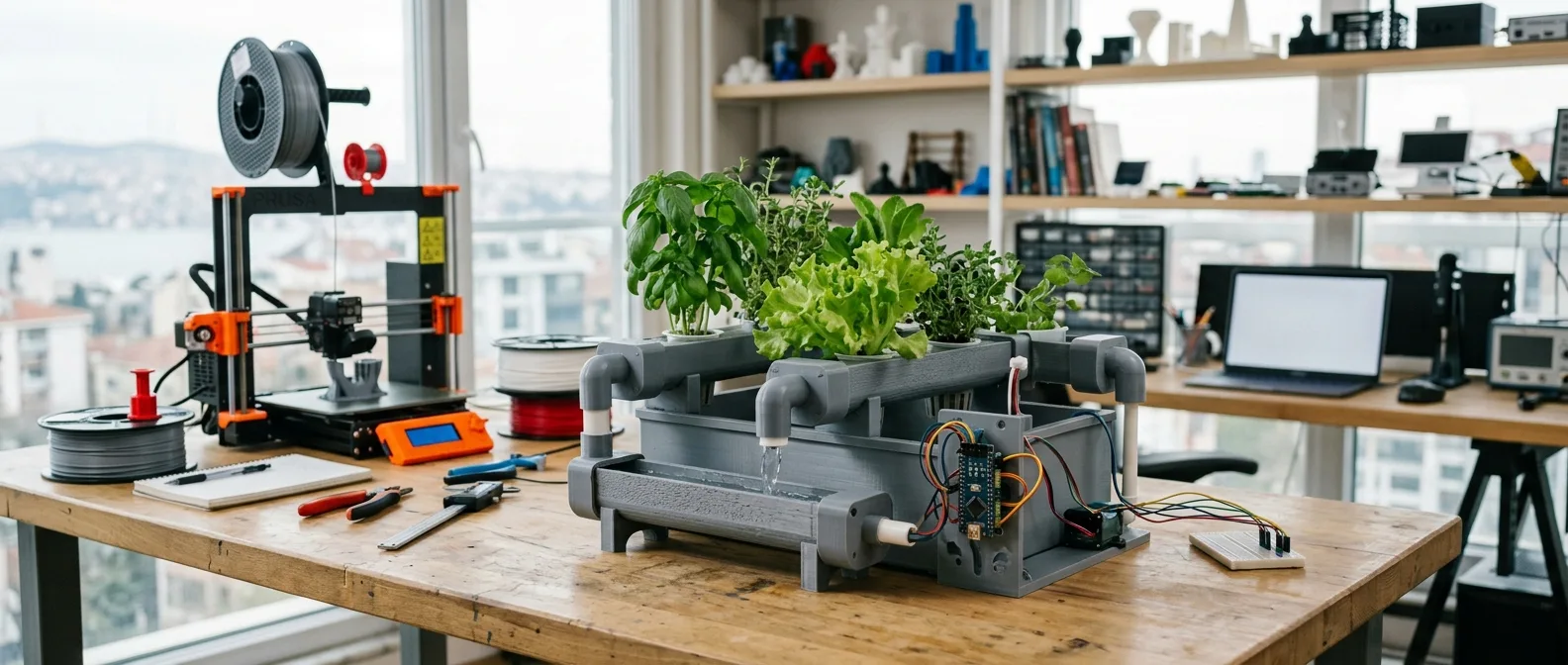
How Hydroponics Prototype works
3D-Printed Hydroponics is a workshop project focused on designing and printing parts for a small-scale soilless farming system. The goal is to build a modular, repairable setup that can scale as needed. The project is currently underway in the workshop, and all experiments are logged publicly in the Lab.
Why not off-the-shelf parts?
Off-the-shelf hydroponic parts are expensive and inflexible for small-scale setups: if a connector breaks or you want to expand the system slightly, finding the right replacement can be tough. 3D printing solves this with custom-sized parts that can be reprinted on demand.
Material selection: PETG and ASA
Material choice is critical for parts exposed to constant water, moisture, and direct sunlight. This project compares PETG and ASA across water and moisture resistance, UV stability, and printability. I shared tips on printing engineering filaments like ASA without warping in my ABS and ASA temperature guide.
Print profile for watertightness
In a water-carrying part, even the tiniest layer gap causes leaks. That’s why I’m testing a watertight-focused slicer profile by tuning wall count, outer shell, and layer settings. Each setting is verified through test prints to see what actually delivers waterproof results.
Modular channels and connectors
The system consists of interlocking channels and connectors. If a part fails, only that piece needs to be reprinted, and expanding the system is as simple as adding new modules. Joint strength and watertightness are also tested during assembly.
Sensor monitoring
An ESP32-based circuit measures humidity and water levels to monitor the system's status. The goal is to catch drops in water level or out-of-range humidity early on.
Functional part production
This project shows that 3D printing isn’t just for prototyping—it can also produce functional parts that work in real-world conditions. If you need help choosing the right printer and materials for your own functional parts, check out my 3D printing and scanning consulting service.
Where the project started
Off-the-shelf hydroponic parts are expensive and inflexible for small-scale setups. With 3D printing, I set out to build a modular, repairable system that scales as needed.
Architecture and flow
What does it offer?
- Wall and layer profile tests for watertightness
- Material comparisons for UV and moisture resistance
- Modular channels and connectors
- Water level and humidity tracking via sensors
- Public logs of all tests in the Lab